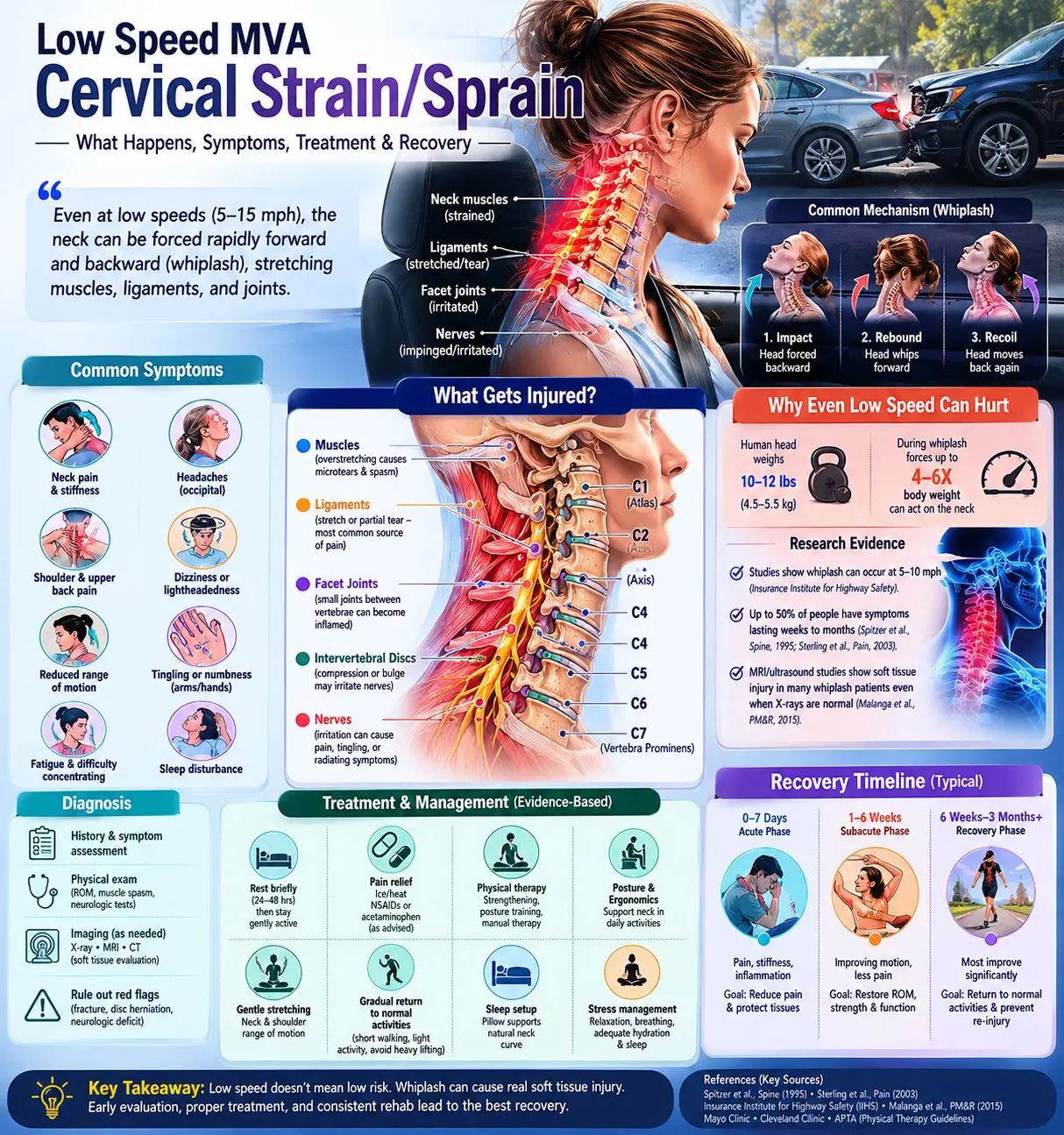
86% of all neck injuries are from motor vehicle accidents.
85% of these are from rear end collisions.
80% of cervical spine fractures are from motor vehicle accidents.
Here Are What Most Chiropractic Patients Receive Help With
- Neck, midback and low back pain
- Tingling and numbness into arms, hands, legs and feet
- Joint limitation
- Lack of coordination
- Functional loss
- Generalized pain
- Sensory loss
- Strength loss
Differences in Treatment
| Chiropractic | Medicine |
|---|---|
| Immediate hands-on therapy | Rest |
| Decrease joint swelling | Immobilization |
| Decrease nerve irritation | Drugs |
| Increase function | |
| Realign spine | |
| Strengthen musculature |
Over a four-to-eight-week period, chiropractic treatment is twice as effective as rest and immobilization. The new federal guidelines state that rest and immobilization should be prescribed for the first three days after an injury. After that it is counterproductive. There is a four times greater likelihood of cervical degenerative osteoarthritis with car accident victims over non-victims. The prognosis for car accident victims is chronic instability, degenerative disc disease spondylosis. As a result of an accident there is pain and weakness, dysfunction, degeneration, and disability.
Important conditions to consider in automobile injuries are the brakes, the road conditions, seat back stiffness, and compressibility of the cars. The victims’ head and neck are subject to two and a half times more force than the vehicle. Up to five times at higher speeds.
Many people have been in accidents but feel they were not injured. How can, we be sure? Why do you suppose I’m asking this question? Almost every other person who comes in our office with a neuromuscular complaint and has had no obvious traumas recently; we trace back to an old injury. The pains from most illnesses and health problems are going to go away on their own. Your brain adapts to just about anything. Scientific research has shown that you can function at half your capacity and not be able to discern if something is wrong. Half of your lungs, kidneys, etc. could be not working and you wouldn’t even feel it.
How do you know you have tooth decay. The dentist has to check. You wake up one morning with a horrible pain in your mouth and the dentist tells you, “you have a hole in your tooth.” Was that decay there yesterday when you didn’t feel it? Of course it was. You see we’re not wired up to feel pain. Only one out of ten nerve fibers is for the detection of pain. If every nerve fiber in our body was for pain just the weight of our clothes would be unbearable.
How you feel is not an indicator of how healthy you are. This is why the most successful doctors are the ones who have tests that can monitor your success. The cardiologist puts the cuff on you and tells you what your blood pressure is. What if I asked you right now what your blood pressure was? Probably wouldn’t want to bet on it. We don’t have a cuff to put around the spine, but we do have x-rays and other clinical tests to determine what is going on with the central nervous system. Remember, 20% of the central nervous system is in the spine. The spine is just an extension of the brain.
So let’s go over these questions. If you haven’t seen this before I’m willing to bet that you will not get these all right.
1. Would you rather be on a bicycle or a truck. So size is important. The insurance adjusters are looking at this factor. We’re going to look at these questions as if we’re the insurance adjusters. The adjusters’ main guide to basing the settlement is how much damage has occurred to the vehicle. So the first thing the adjuster reads on the report since he wasn’t there is the size of the vehicles.
2. Next factor is speed. By the way, mass times velocity equals momentum. We all know that a baseball struck squarely by a bat is harder to stop than the same baseball thrown gently, and that the heavy iron ball used for the shot-put is harder to stop than a baseball whose velocity is the same. These observations suggest that a measure of the tendency of a body to continue in motion at constant velocity is the product of its mass and velocity. Exactly what these first two questions pertain to.
3. The quantity of muscles protecting the spine is important. With all factors being equal, females are more often injured. Of course, there are small – framed men and strong athletic women. Also, it’s been found that if a woman is menstruating at the time of the accident the injuries are more severe because of lowered serum calcium levels.
4. The age is factored in by the adjuster in terms of well he is injured, but he only has a life expectancy of x so even though probability states that an older person will be more injured, the value of this is diminished in terms of settlement. So often this turns out to be a wash if we’re talking about long term serious injury. From an attorney’s point of view, he is most concerned with an overweight woman in a small car hit at high speed by a large vehicle. This patient is in trouble.
5. Head rests really should be called head restraints since you are not supposed to be resting your head on it. 80% of the head rests checked in accidents were not set properly. This makes sense since if you’re sharing the car with your spouse, you are probably of different heights. Most people don’t check the head rest to see if it’s at the right height. If the rest is too low it is now not a restraint but is now acting as a fulcrum and can cause more severe injuries. Better to keep it high. It only works if your head hits it.
6. One reason why your head would not hit the restraint is that your back is not against the seat. If there is a considerable space between your back and the seat, then by the time your head does hit the rest, it’s already been hyper-extended. A situation where this could occur is someone with a hunch back. Something we see quite often in post-menopausal women. Anyone whose head is leaning too far forward is going to be injured more severely with all factors being equal. If the seat is too far back as in a sports car, your body is not only being thrown back, but it’s also being thrown up. It’s called ramping. The seat acts as a ramp. And your head is further up.
7. The belts prevent face injuries but increase neck injuries because they hold your body rigid, and your neck is thrown around. Instead of the forces being distributed throughout your body, they’re concentrated in the neck. Since only one shoulder is being restrained, there is also a considerable amount of torque added to the low back area because of the twisting.
8. The injury is increased if the victim’s head is turned at the time of impact, which is often the case because they’re looking to see where this noise is coming from. Let me demonstrate. Everybody move their head down and now back. Now do it but first turn your head. Which way do you have a wider range of motion? How would you like to have the same accident, but now your head is turned. You don’t want your head thrown back and forth in this position. So try not to get hit when you’re reaching over for the cigarette lighter or changing the media player.
9. The bumpers are on the front and back of cars. You don’t want to get broadsided because you have less protection and as I already stated, your head does not move well in this direction.
10. The whole injury in an accident occurs from the body being moved. If you were in a coat of armor, the likelihood of injury would be none. The damage is done upon acceleration and deceleration. The body is beingg thrown around. The car being pushed or spun around increases the odds of acceleration deceleration.
11. If the car crumples it will absorb more force than you. In a car that does not crumple, the occupants are in greater jeopardy.
12. So obviously, this question way back above is yes. The amount of damage to the car is not equal to the amount of injury sustained to the passengers.
I strongly suggest that all accidents be evaluated within the first two weeks.
By the way, it’s better to tense up if you can during the accident. The muscles will be sore, but you’ll have braced the spine and have protected the more sensitive nervous system. The muscles will recover in a few months, but it’s possible the spine will never recover.
If you found this interesting, you may also enjoy the opinion piece my friend (Dr. Brian Augustine, of Wesley Chapel, FL) wrote: https://augustine-chiropractic.com/auto-accident-whiplash-injuries-why-a-chiropractic-evaluation-matters/
Please note that Dr. Brian Augustine and Dr. Greg Malakoff are separate unrelated practices and what he shares is his opinion. The views expressed by Dr. Augustine are not necessarily those of Dr. Greg Malakoff.